Ten Practical AI Uses for TEFL Teachers
Discover ten practical ways TEFL teachers can use AI for lesson planning, classroom activities, differentiation, feedback and professional development. This article covers Ten Practical AI Uses for TEFL Teachers.
In this article, we will explore Ten Practical AI Uses for TEFL Teachers.
Artificial intelligence is becoming an increasingly useful part of English language teaching. For TEFL teachers, AI can help reduce preparation time, generate new ideas and provide additional support for learners.
However, AI should not replace the teacher’s professional judgement. The most effective use of AI is as a teaching assistant: a tool that helps teachers create, adapt and improve learning materials while the teacher remains responsible for accuracy, suitability and quality.
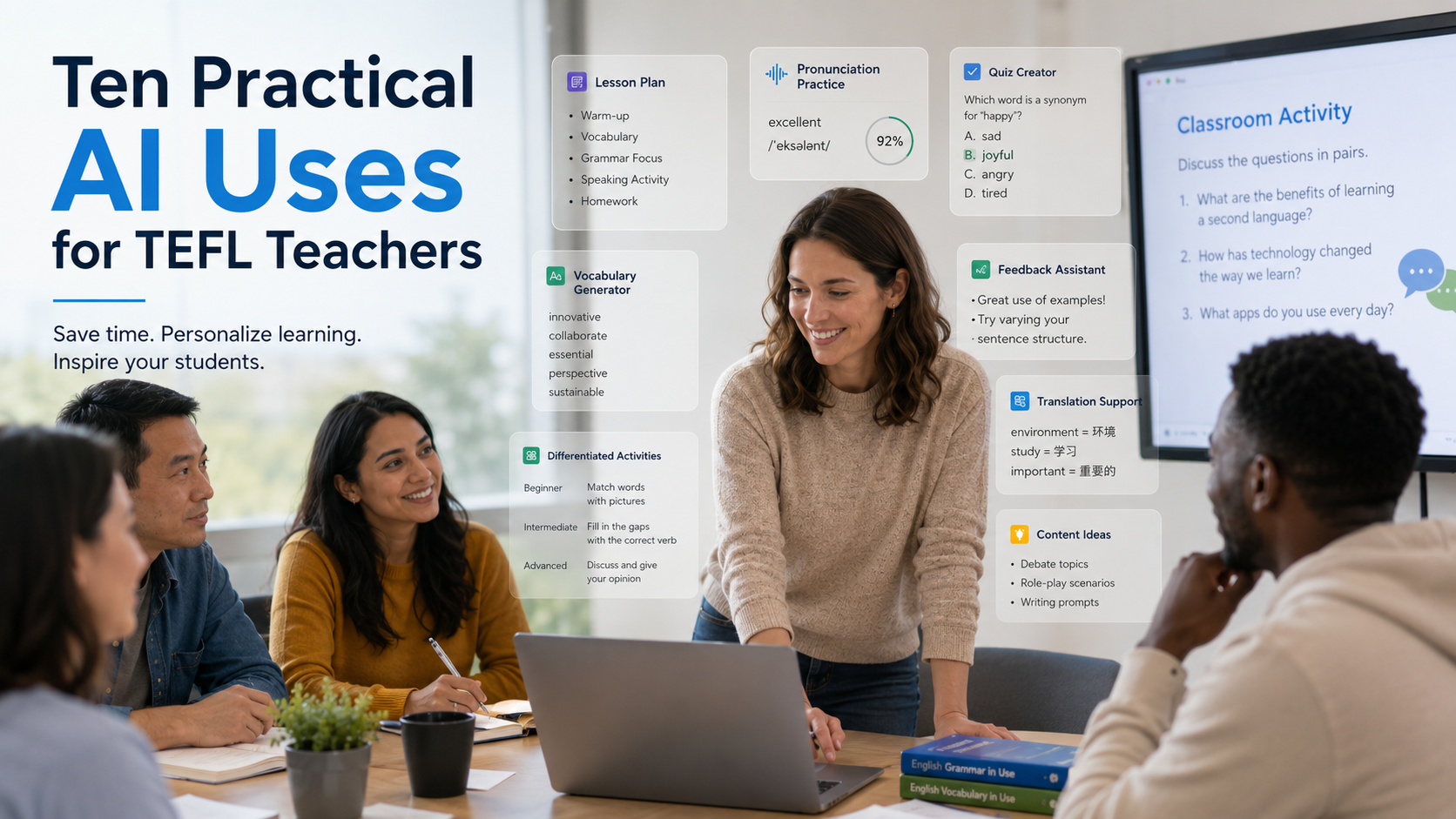
Below are ten practical ways TEFL teachers can use AI in their everyday work.
1. Creating lesson plan ideas
AI can help teachers generate an initial lesson structure based on a particular level, topic, age group or language objective.
For example, a teacher could ask an AI tool to suggest a 60-minute lesson for an intermediate adult class on the topic of travel. The response might include:
- A warm-up activity
- Target vocabulary
- A reading or listening task
- Controlled practice
- A speaking activity
- A short review task
This can be especially useful when a teacher needs inspiration or is planning several lessons in a limited amount of time.
The teacher should always adapt the suggested plan to suit the learners. AI does not know the individual personalities, needs, abilities or interests of a particular class.
2. Producing vocabulary activities
AI can quickly create vocabulary lists and practice activities for almost any topic.
Teachers can use it to generate:
- Word-definition matching activities
- Gap-fill exercises
- Synonym and antonym tasks
- Vocabulary categorisation activities
- Example sentences
- Collocation exercises
- Discussion questions using target words
A teacher preparing a lesson on employment, for example, could ask for ten useful job-related words at B1 level, together with definitions and example sentences.
It is important to check that the vocabulary is appropriate for the learners’ level and that the example sentences sound natural.
3. Adapting texts for different levels
Authentic texts are often too difficult for lower-level learners. AI can help simplify an article, story or information text while retaining its main meaning.
A teacher might ask an AI tool to rewrite a news-style text at A2, B1 or B2 level. The teacher could also request:
- Shorter sentences
- Simpler vocabulary
- Explanations of difficult words
- A glossary
- Comprehension questions
- A summary task
This can help teachers use the same general topic with mixed-ability groups.
However, simplified texts must be reviewed carefully. AI may occasionally remove important information, change the meaning or produce language that is unnatural.
4. Generating reading comprehension questions
Creating good comprehension questions can take time. AI can produce a range of questions based on a text supplied by the teacher.
These might include:
- True or false questions
- Multiple-choice questions
- Short-answer questions
- Vocabulary-in-context questions
- Inference questions
- Discussion questions
- Summary tasks
Teachers should check that each question has a clear answer and that the difficulty matches the learners’ level.
It is also helpful to include questions that encourage learners to think beyond the text rather than simply locate individual words or sentences.
5. Creating grammar practice
AI can generate targeted practice for grammar points such as:
- Present and past tenses
- Conditionals
- Modal verbs
- Articles
- Prepositions
- Reported speech
- Passive structures
- Relative clauses
A teacher could request ten gap-fill sentences practising the present perfect, followed by a short speaking activity using the same structure.
Teachers can also ask AI to produce common errors for students to correct. This can be useful for revision and error-awareness activities.
All grammar explanations and answer keys should be checked. AI can sometimes provide an inaccurate explanation or create an example that is grammatically possible but unsuitable for the intended teaching point.
6. Developing speaking and discussion activities
AI can help teachers create speaking tasks for different ages, levels and interests.
Possible activities include:
- Role-plays
- Debate topics
- Problem-solving tasks
- Information-gap activities
- Interview questions
- Picture discussion prompts
- “Would you rather?” questions
- Situational dialogues
For example, a teacher could request a role-play for two intermediate learners checking into a hotel, including useful phrases and a simple problem for them to solve.
AI can also provide follow-up questions that encourage longer and more meaningful answers.
The teacher should ensure that discussion topics are culturally appropriate and do not make learners uncomfortable.
7. Providing writing models
Learners often benefit from seeing a clear model before completing a writing task.
AI can create examples of:
- Informal emails
- Formal letters
- Reports
- Reviews
- Descriptions
- Opinion essays
- Stories
- Job applications
- Social media posts
The teacher can ask for a model at a specific language level and then use it to analyse structure, vocabulary, linking words or tone.
A model should not simply be given to students to copy. It is more useful when learners identify its main features and then produce their own version.
Teachers should also explain that AI-generated writing may sound polished but can still contain weak arguments, repetition, factual errors or inappropriate language.
8. Supporting differentiation
In many TEFL classrooms, learners do not all work at the same level or speed. AI can help teachers produce different versions of the same activity.
For example, one reading task could be adapted into:
- A simpler version with a glossary
- A standard version
- A more challenging version with inference questions
- An extension task for faster learners
AI can also produce additional sentence starters, vocabulary support or guided questions for learners who need more help.
This allows teachers to respond more effectively to mixed-ability classes without creating every resource from the beginning.
Differentiation should remain based on the teacher’s knowledge of the learners rather than assumptions made by an AI system.
9. Creating feedback frameworks
AI can help teachers prepare feedback checklists, marking criteria and self-assessment forms.
For a writing task, a checklist might ask learners to consider:
- Have I answered the question?
- Is my writing clearly organised?
- Have I used paragraphs?
- Have I checked verb forms?
- Have I used suitable linking words?
- Have I checked spelling and punctuation?
Teachers may also use AI to suggest feedback wording. For example, it can produce constructive comments that recognise strengths while identifying an area for improvement.
Confidential student information should not be entered into public AI tools without appropriate permission and data protection measures. Teachers should avoid uploading personal details, assessment records or identifiable student work unless the platform has been approved for that purpose.
10. Supporting teacher development
AI is not only useful for creating classroom materials. It can also support teachers’ own professional development.
Teachers can use AI to:
- Explore different teaching methods
- Review terminology
- Generate reflective questions
- Compare lesson-planning approaches
- Practise interview questions
- Brainstorm research topics
- Create professional development goals
- Summarise notes from training sessions
For example, a teacher could describe a lesson that did not go as planned and ask for possible reasons and alternative approaches.
The response should be treated as a starting point for reflection rather than a final professional judgement. Advice from experienced colleagues, trainers and recognised academic sources remains important.
How to write better AI instructions
The quality of an AI response often depends on the quality of the instruction given to it.
A useful instruction should include:
- The learners’ level
- Their age group
- The lesson topic
- The language objective
- The length of the lesson
- The type of activity required
- The number of questions or examples
- The preferred variety of English
- Any vocabulary or grammar to include
- Any subjects or content to avoid
Instead of writing:
“Create a speaking activity.”
A more effective instruction would be:
“Create a 15-minute pair-speaking activity for adult B1 English learners. The topic is travel problems. Include role cards, six useful phrases and a short follow-up discussion. Use British English.”
Clear instructions usually produce more relevant and usable results.
Checking AI-generated materials
Teachers should never assume that AI-generated content is automatically correct.
Before using any material, check:
- Grammar and spelling
- Factual accuracy
- Learner level
- Cultural suitability
- Clarity of instructions
- Accuracy of answer keys
- Natural use of English
- Relevance to the lesson objective
- Possible bias or inappropriate content
- Copyright and data protection considerations
The teacher remains responsible for all materials used in the classroom.
Using AI responsibly
Responsible AI use involves more than checking grammar. Teachers should also consider privacy, fairness and academic honesty.
Students should understand when AI use is permitted and when work must be completed independently. Teachers may need to establish clear rules for homework, writing tasks and assessments.
Learners should also be taught to question AI-generated information, check sources and recognise that a confident answer is not necessarily an accurate one.
AI literacy is becoming an important part of education. This includes knowing how to use AI effectively, but also knowing when not to use it.
Develop your teaching skills with LTTC
London Teacher Training College supports trainee and practising teachers through flexible TEFL and TESOL programmes designed for modern teaching environments.
LTTC courses combine teaching methodology, practical classroom skills and professional development, helping teachers prepare for work in classrooms, online and internationally.
To learn more about LTTC teacher-training programmes, visit www.teachenglish.co.uk.
| EL Gazette for latest TESOL/TEFL global news! |